Voice Assistant vs AI Companion for Elderly Parents: What's the Difference?
By Shivansh Joshi, Founder, Reca · 4 min read · Updated August 27, 2026
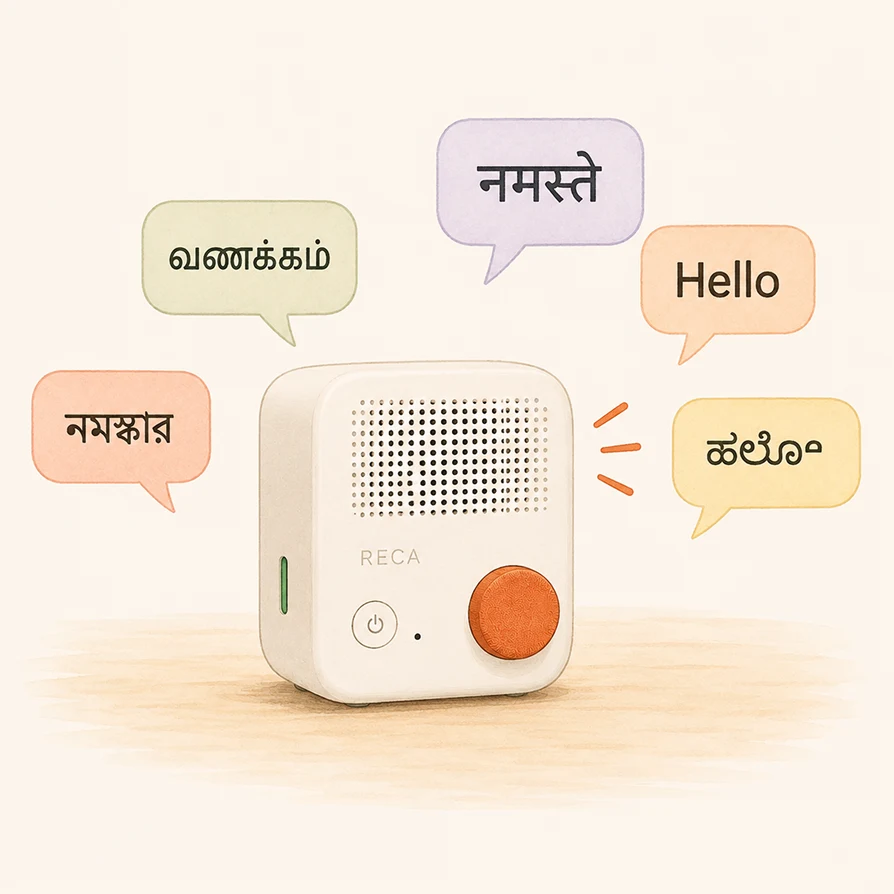
The short answer: a voice assistant (Alexa, Google Nest) executes commands — timers, weather, music. An AI companion is built for relationship — it starts conversations, remembers the person, and is designed specifically to ease loneliness, which a smart speaker was never built to address. “Just get them an Alexa” is common advice for a lonely or isolated parent; sometimes it’s right, often it misses the point. Here’s the actual difference, and how to choose.
A voice assistant is a tool
Smart speakers are command machines. You ask, they execute: weather, timers, music, a quick fact, smart-home control. They’re:
- Reactive — they wait for a command and a wake word.
- Transactional — built for tasks, not conversation.
- Brilliant for utility — reminders, hands-free calls, music, lights.
For an active senior who wants convenience, a smart speaker is great. But it doesn’t keep them company — it answers and goes quiet.
An AI companion is a presence
An AI companion is built for relationship, not commands:
- Proactive — it can start conversations and check in, not just wait.
- Conversational — it talks naturally and holds a thread.
- Personal — it remembers who the person is, their routines, their stories.
- Built for elders — often no wake word, no app, no screen; just talk.
Where a voice assistant does things, a companion is with them.
Side by side
| Voice assistant (Alexa/Google) | AI companion | |
|---|---|---|
| Main job | Tasks & commands | Conversation & company |
| Starts conversations? | No | Yes |
| Remembers the person? | Limited | Yes |
| Needs wake word / app | Usually | Often not |
| Helps with loneliness | A little | That’s the point |
| Designed for | General households | Elders specifically |
What “proactive” actually looks like day to day
This is the part that’s hard to picture until you see it. A smart speaker will play a song if asked. A companion will notice it’s evening, ask how the day went, remind them about an evening walk or medicine, and hold a short back-and-forth about whatever’s on their mind — without being asked to do any of it. For a parent who lives alone for long stretches, that unprompted check-in is often the only conversation they have between your calls.
Privacy: a fair question either way
Any always-listening device deserves scrutiny. The honest answer is that it depends on the maker, not the category — a voice assistant can be privacy-respecting, and a companion can be poorly built. Look for: clear language on what’s recorded and for how long, no third-party ad targeting from conversations, and a company that’s transparent when asked directly. Favor devices built for companionship over ones built to sell you things through the conversation.
Which should you choose?
- Your parent is capable and just wants convenience (music, reminders, calls): a smart speaker is perfect and inexpensive.
- Your parent is lonely, lives alone, or struggles with fiddly tech: an AI companion addresses the actual problem. (Unsure? Read the signs your aging parent is lonely.)
And if your parent is an Indian elder, language matters enormously. A mainstream assistant in English is a different experience from a companion that talks with them in Hindi, Tamil, Telugu, Bengali or Marathi about a life it understands. That’s why we built Reca — companionship first, in their own language.
FAQ
Is Alexa good for elderly parents? For utility — reminders, music, hands-free calls — yes. For loneliness, it’s limited: it reacts to commands but doesn’t hold conversation or keep company.
What’s the difference between a smart speaker and an AI companion? A smart speaker does tasks on command. An AI companion is built for conversation and presence — it starts chats, remembers the person, and aims to ease loneliness.
Can I use both a smart speaker and a companion? Yes, and many families do — a smart speaker for reminders and music, a companion for the conversational and check-in piece. They solve different problems, not competing ones.
Do AI companions work well for parents who don’t speak English? Only if the companion is actually built for the language, not just translated. Look for natural conversation (not command parsing) in the parent’s own language — this is where most Western AI companions fall short for Indian elders, and where Reca is built specifically to work.