How to Feel Close to Aging Parents When You Live Abroad
By Shivansh Joshi, Founder, Reca · 4 min read · Updated August 27, 2026
The short answer: if you live abroad while your parents age back home, you know the particular weight of it — the 3 a.m. worry, the guilt when you miss a call, the helplessness when something goes wrong and you’re a flight and a timezone away. You’re far from alone in this: research on the Indian diaspora found 54% of adults aged 40-55 living outside India have a living parent aged 65 or older (Samarth Elder Care), and organised elder care in India reaches fewer than 1% of the elderly population — meaning family, from afar, usually is the safety net. You can’t move countries on a whim. But you can build real closeness across the distance. Here’s how families actually do it.
1. Trade grand gestures for steady rhythm
A reliable 20-minute call every Sunday does more than a heroic month-long visit once a year. Pick a fixed time that works across timezones and protect it. Predictability is its own comfort — they look forward to it all week.
2. Kill the tech friction on their end
Most missed calls aren’t about love; they’re about a confusing phone. Set up one-tap video calling on a device built for elders. The easier it is for them, the more it happens.
3. Make your presence ambient, not just scheduled
Between calls, let them feel you around:
- A photo frame you feed remotely so the grandkids “visit” daily.
- A shared family chat where photos land through the day.
- A voice companion they can talk to any time — company in the hours you’re asleep.
4. Build a local safety net
Closeness includes knowing they’re okay. Line up a trusted neighbor or relative, a house-help who checks in, and simple safety tech (medical-alert wearable, medicine reminders). It quiets the 3 a.m. worry. Given how thin organised elder care is in India, this informal safety net often ends up doing the job a care facility would elsewhere — worth building deliberately rather than assuming it’ll come together on its own.
5. Plan for the time difference honestly
If you’re in the US or Canada, your evening is often their early morning, and vice versa for the UK, Gulf, or Australia. Rather than fighting the clock every week, pick the slot that’s least likely to get cancelled on either end — often a weekend morning for them — and treat it as fixed, not “whenever works.”
6. Name the guilt, then put it to work
Distance guilt is near-universal among NRIs and anyone living away. It isn’t proof you’re failing — it’s proof you care. Channel it into systems (rhythm, tech, a safety net) instead of letting it sit as background dread.
The honest gap
Even with all of the above, there’s a gap calls can’t fill: the everyday “did you take your medicine, did you eat, how was your afternoon.” For a parent who lives alone, those quiet hours are the hardest part.
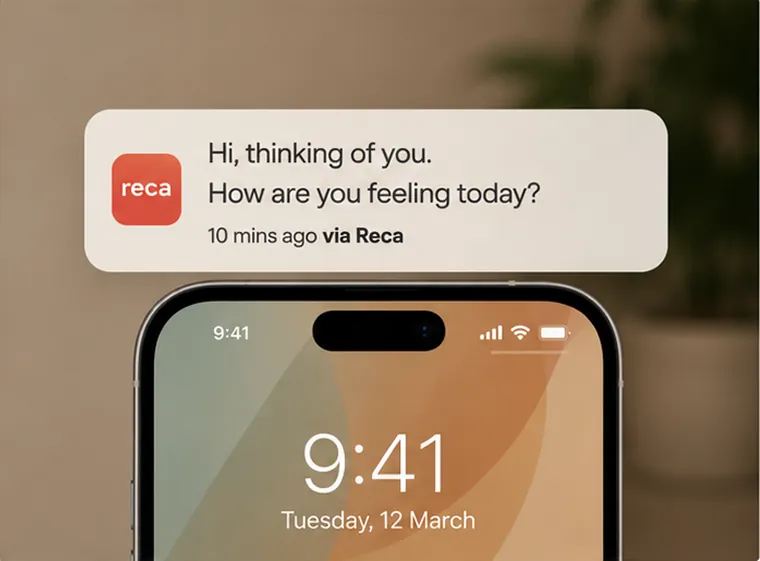
That gap is why we built Reca — a voice companion made for Indian elders. It talks with your parent in their own language, remembers their routines and prayers, and keeps them company in the in-between. Not a replacement for you. A bridge for the hours you can’t be there.
When you’re ready to send something home, see Father’s Day gifts to send parents in India and gifts for parents who live far away.
FAQ
How can I stay close to my parents when I live in another country? Build a steady call rhythm, remove tech friction on their side, make your presence ambient (shared photos, a companion device), and set up a local safety net so you worry less.
How do I deal with guilt about living far from aging parents? Accept it as a sign you care, then convert it into systems — routines and support that genuinely help — rather than letting it run as anxiety.
How many NRIs actually deal with this situation? More than you’d think — over half of Indian-origin adults aged 40-55 living abroad have a living parent aged 65 or older, and fewer than 1% of India’s elderly have access to organised care. If it feels like an unusually heavy burden, that’s because for most NRI families, it structurally is.
What’s the single highest-impact thing I can do from abroad? A steady, predictable call rhythm consistently matters more than grand gestures or infrequent visits. Everything else — tech, a local safety net, a companion device — supports that rhythm rather than replacing it.